
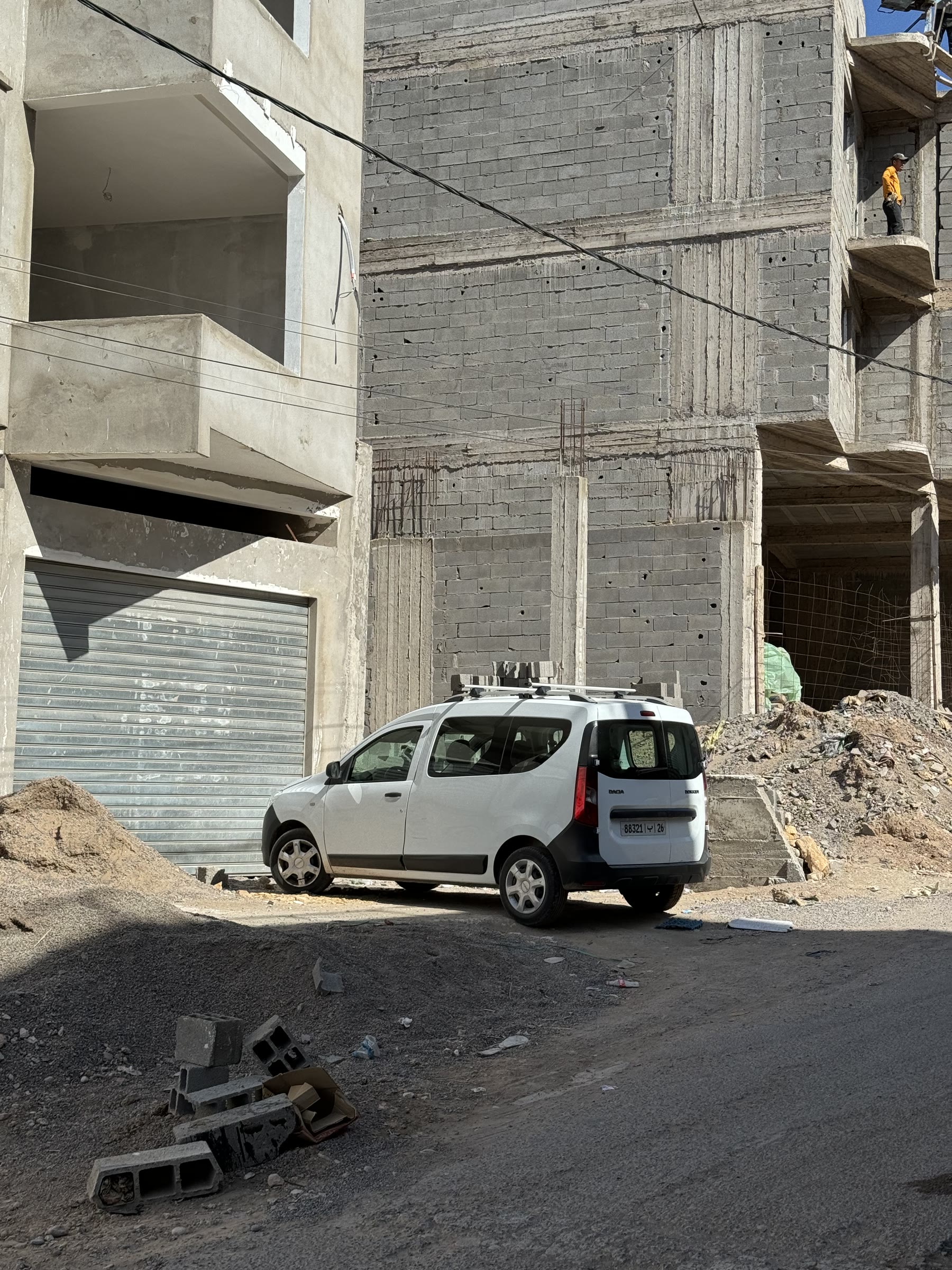
A guy called Youssef, a car rental office inside a Marrakech apartment, a Heineken placemat and three strangers drinking tea. How trying to save 100 euros cost us 50 more - and got us the best car for the trip.
The decision took two minutes, like all bad decisions do. The desks at Marrakech airport were renting cars for 350 euros. A local dealer we found online was asking for 250.
A hundred euros is a hundred euros. And we're grown men - we won't get played.
Hold onto that sentence. We'll need it.
First floor, iron door
His name was Youssef. Dark curly hair, a wide smile, and a look so sincere you believed it before he'd even spoken.
Or so we thought.
The “office” was an apartment in one of those middle-class apartment blocks in Marrakech - beige, square, with cables running across the front and a courtyard that was once somebody's architectural plan. We followed Youssef up. He stopped in front of an iron security gate, unlocked it, revealing a second security door behind it, unlocked that too, and we went in.
The inside was a masterclass in how to build an office out of things that just happened to be there. On the table, a placemat advertising Heineken. On the wall, two Royal Air Maroc posters for its upcoming Boeing 737-400s - ads announcing the future sometime in the late 90s, left there to fade exactly where the sun hit them. The future had come, had flown its whole life, had already retired. The poster hadn't gotten the memo.
And three men sitting there, slowly sipping tea so sweet you could hear it, never looking at us and never explained to us why they were there. They weren't working. They weren't waiting. They were part of the room, like the 737s.
We sat down. And then came the line.
The upgrade
The cheap car, Youssef explained, was unfortunately not available. But not to worry: he'd upgrade us to a bigger one. The bigger one, naturally, wasn't ready yet.
Four hundred euros.
Fifty more than the most expensive price we'd seen at the airport, which was forty minutes and one decision we hadn't made away.
The impressive part wasn't the con. It was the calm with which it was executed. No tension, no strain in the voice, zero need to convince us. The man knew we'd already climbed the stairs and already passed through two doors. You know when a negotiation is over? When one side knows the other won't walk back down those stairs.
We paid. He told us to go grab a coffee and he'd call us when the car was ready.
The café that watched the street
The next stop was a neighbourhood café in one of those parts of Marrakech where tourists don't set foot, because there's no reason to. Two twenty-five-year-old Greeks who wouldn't pass for locals from a distance, from behind, or with a great deal of goodwill.
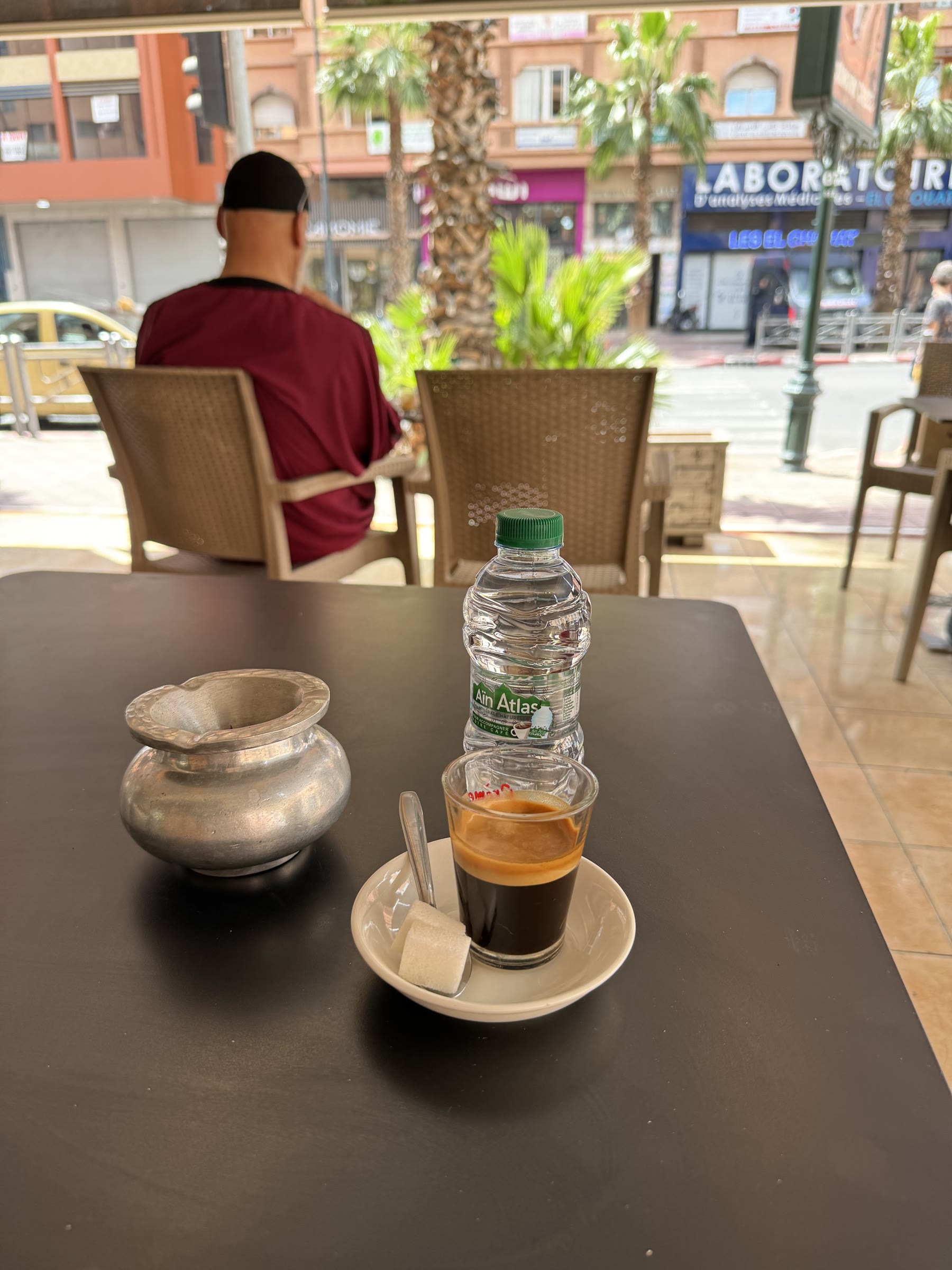
The place was set up like every place there: every chair turned to face outward, in rows, like a theatre. Nobody looked at the person next to them. Everybody looked at the street.
And then we walked in. One of the very few times in our lives we've felt like Victoria's Secret models - every eye pinned on us, and zero idea, on our part, how to handle that gracefully. We walked in decisively, held up two fingers for two coffees, they showed us a number, the transaction concluded without a single word exchanged.
We took our seats. Side by side, turned outward, like everyone else. And we started watching what everyone else was watching.
Within ten minutes we'd stopped being the show. We'd become the audience too. And to this day, years later, we still haven't figured out what exactly it was we were watching.
Meanwhile, over our coffees, we reached the conclusion of the day: the fake rental office had been excellent work. The apartment block, the two doors, the placemat, the 737s, the three men with their tea - the whole set dressed to take our money. We took our hats off to him. Genuinely. Sitting there, coffee in hand, we admired, professionally, the man who had just conned us.
Three men and a garden hose
The phone rang two hours later. Unexpectedly, if I'm honest.
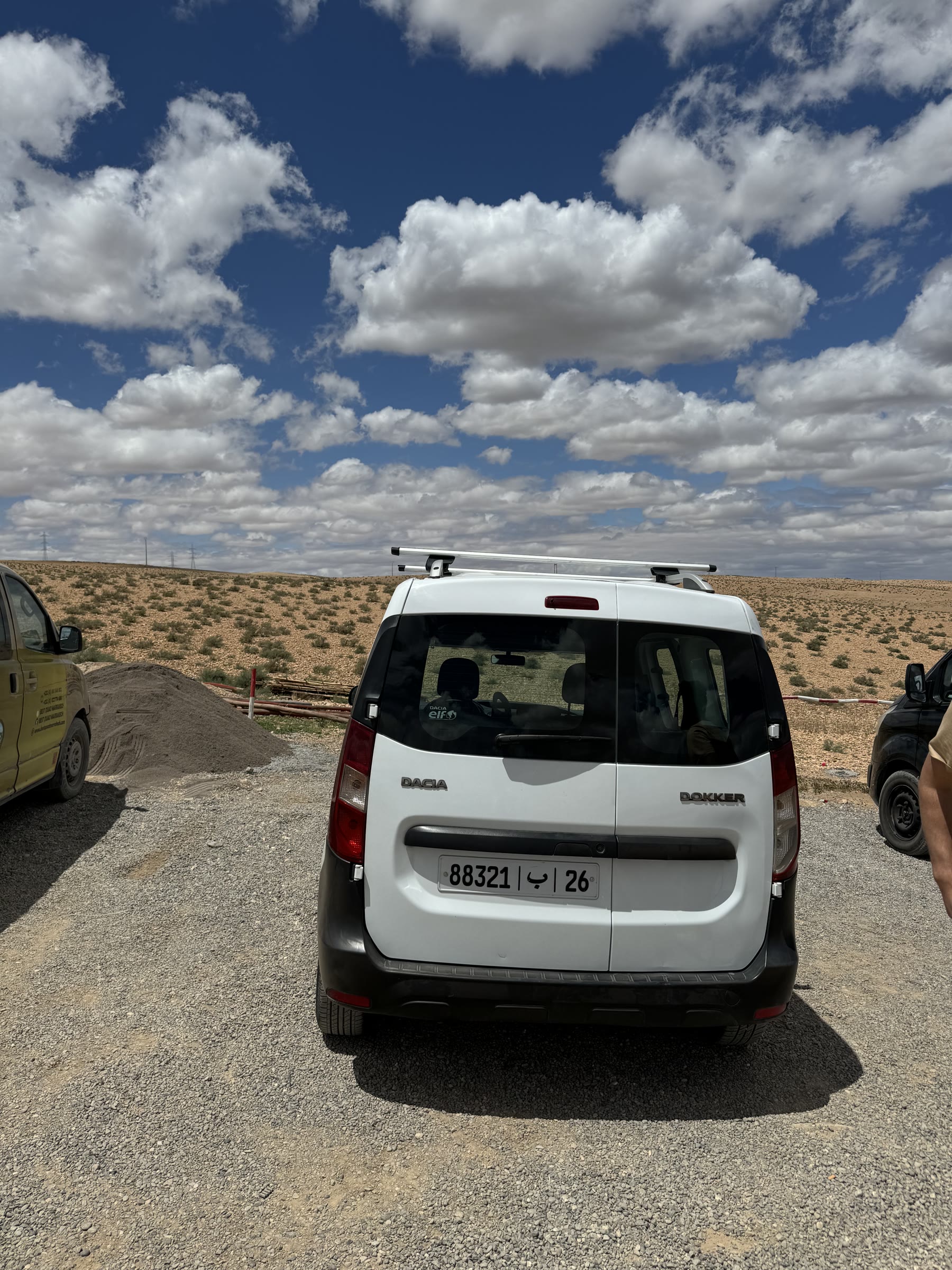
Approaching the building again, we saw three men crouched around a white Dacia Dokker, washing it with a hose and sponges. We looked at each other. Ours, apparently, hadn't arrived yet.
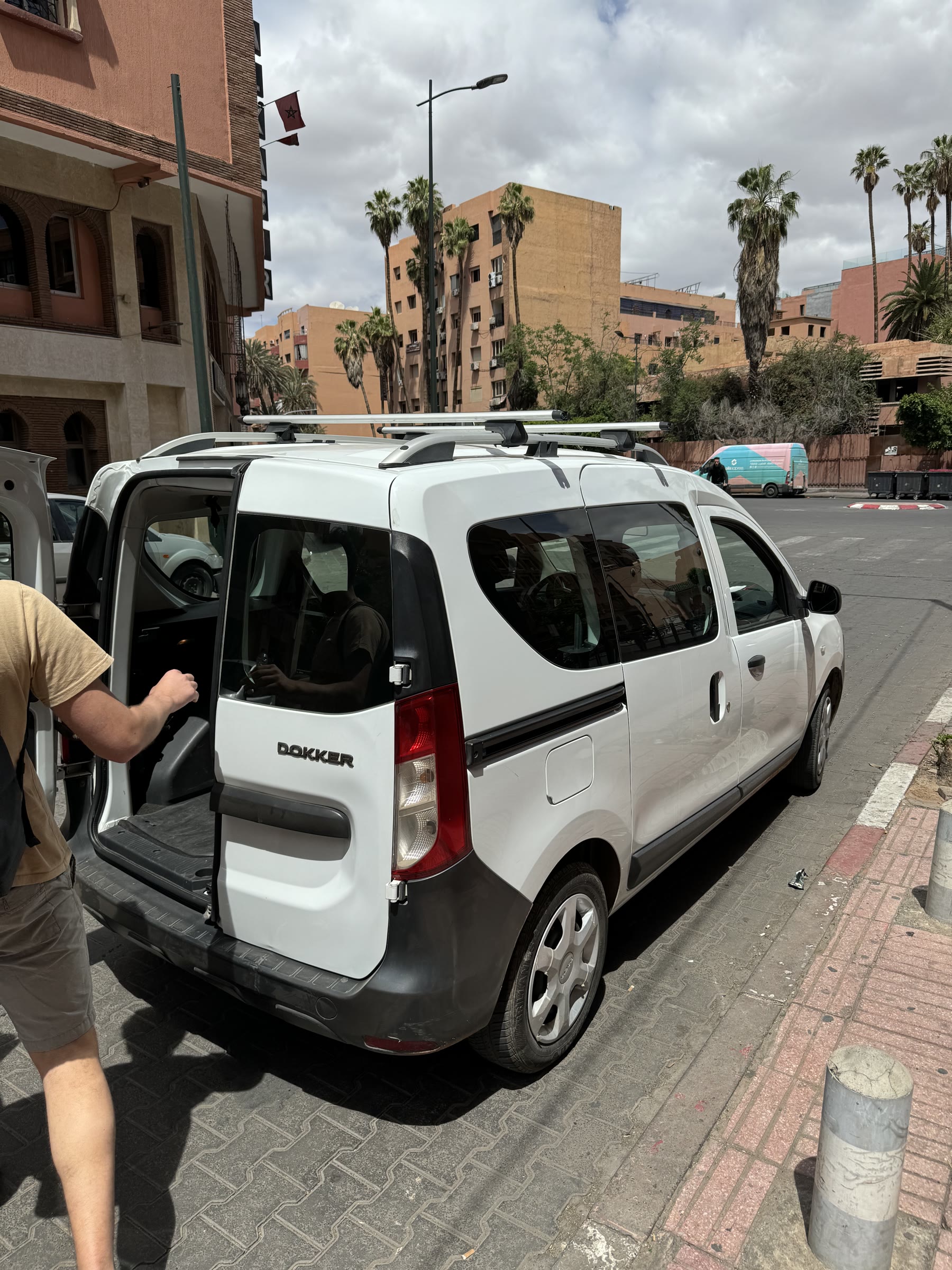
Ten minutes later, we were starting up this exact Dokker, bound for Taghazout.
The “big car” was, technically, real. A humble van with sliding doors, built - and here's the nice part - a few hundred kilometres north, at Renault's factory in Tangier.
The medina: Mario Kart, no restart button
Before we'd even made it out of the city, we got the best driving lesson of our lives.
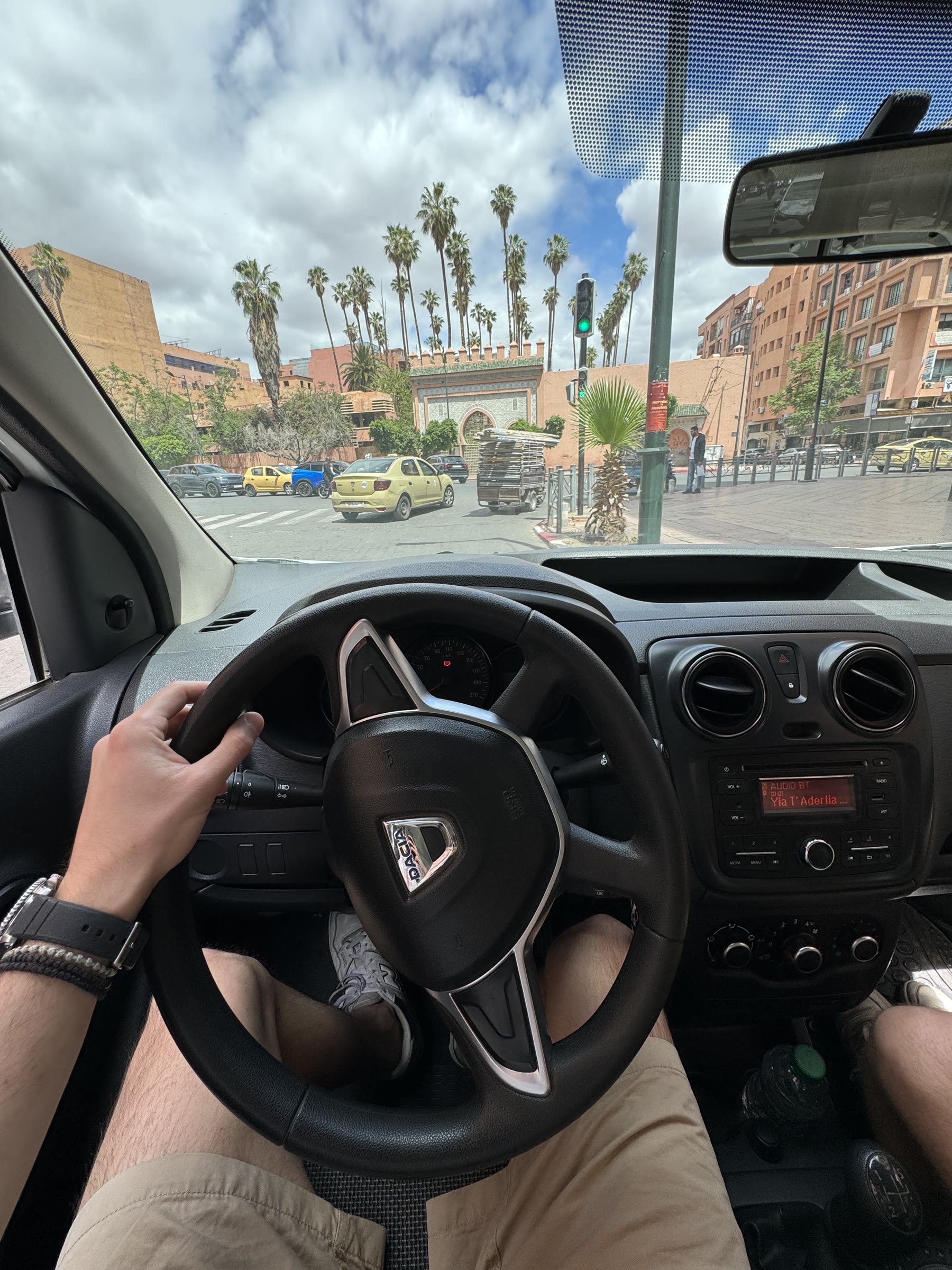
The medina in Marrakech has no lanes. It has current. Mopeds in swarms, from four directions at once, passing at distances that in Greece would be a claim to your insurance company. Handcarts, mopeds carrying three people, mopeds carrying a whole door strapped to the side, pedestrians crossing without turning their heads because they know - correctly - that you'll avoid them.
Dimitris and I said nothing. No music, no talking, not even a joke. Just four eyes trying to read a system with rules we didn't have.
The closest I can get to describing it is Mario Kart. Except here there's no restart button, and every mistake comes with sheet metal and people attached to it.
We came out onto the A7 with our hands smelling of steering wheel.
The door
Four hundred kilometres of motorway, the Atlantic on our right, the plain drying out around us.
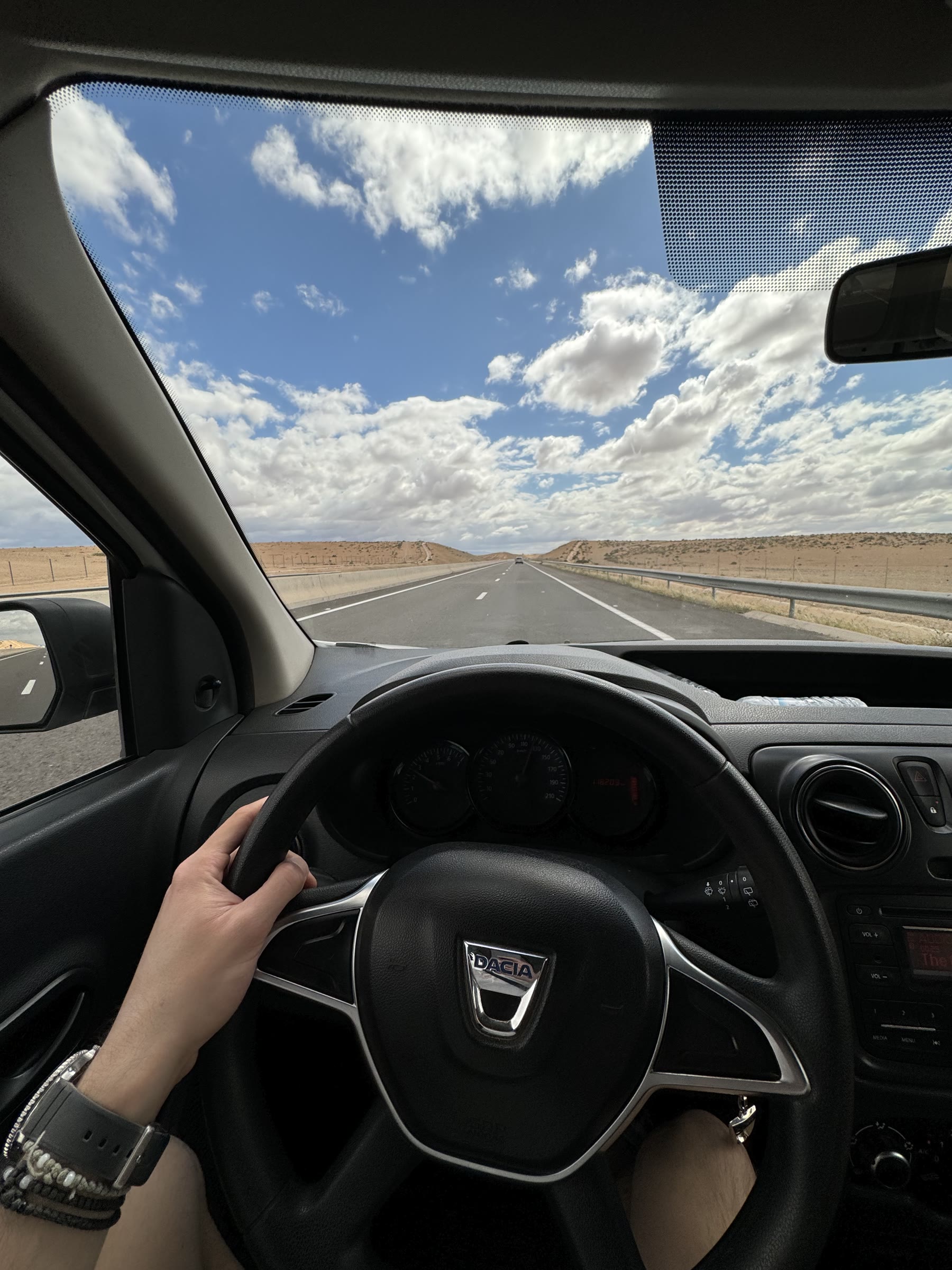
Somewhere in there, windows shut and the AC on 18, a warm little breeze reminded us of something we'd already suspected: the Dokker's sliding door was bent and didn't quite close.
We looked at it. We looked at each other.
What could possibly go wrong, we thought. A little dust'll get in.
We carried on.
Taghazout
We arrived late in the afternoon, and the last stretch of the drive was the strangest part.
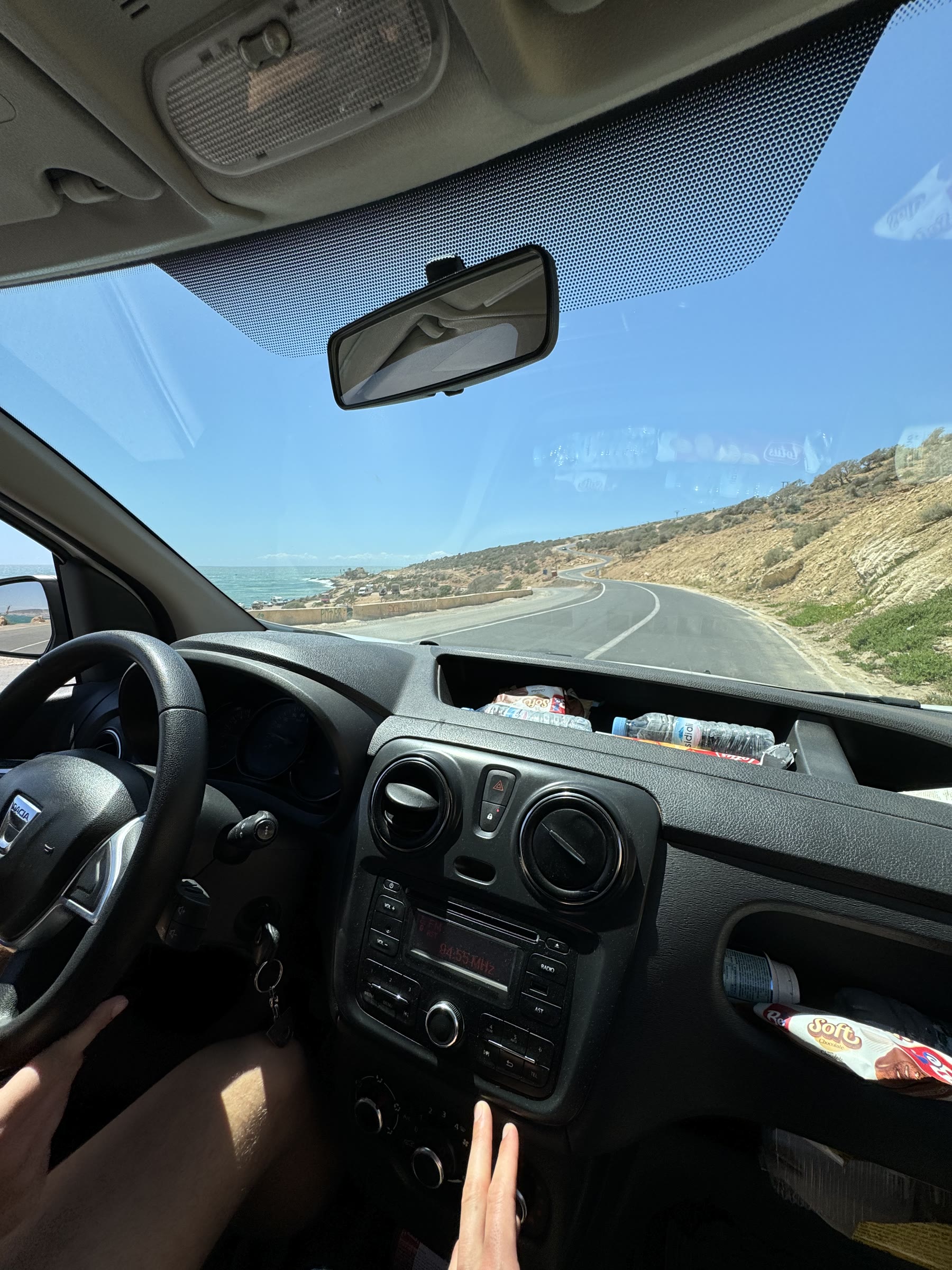
The place we were staying was somewhere up the hillside, and the road there wasn't a road. It was courtyards. You'd drive between hanging laundry, past tables where people were eating, brushing past open doors. At one point, if you'd reached your hand out the window, you'd have touched the wall of someone's living room. Nobody looked up. Apparently cars drive through here every day, and apparently that's normal here, and you're the odd one.
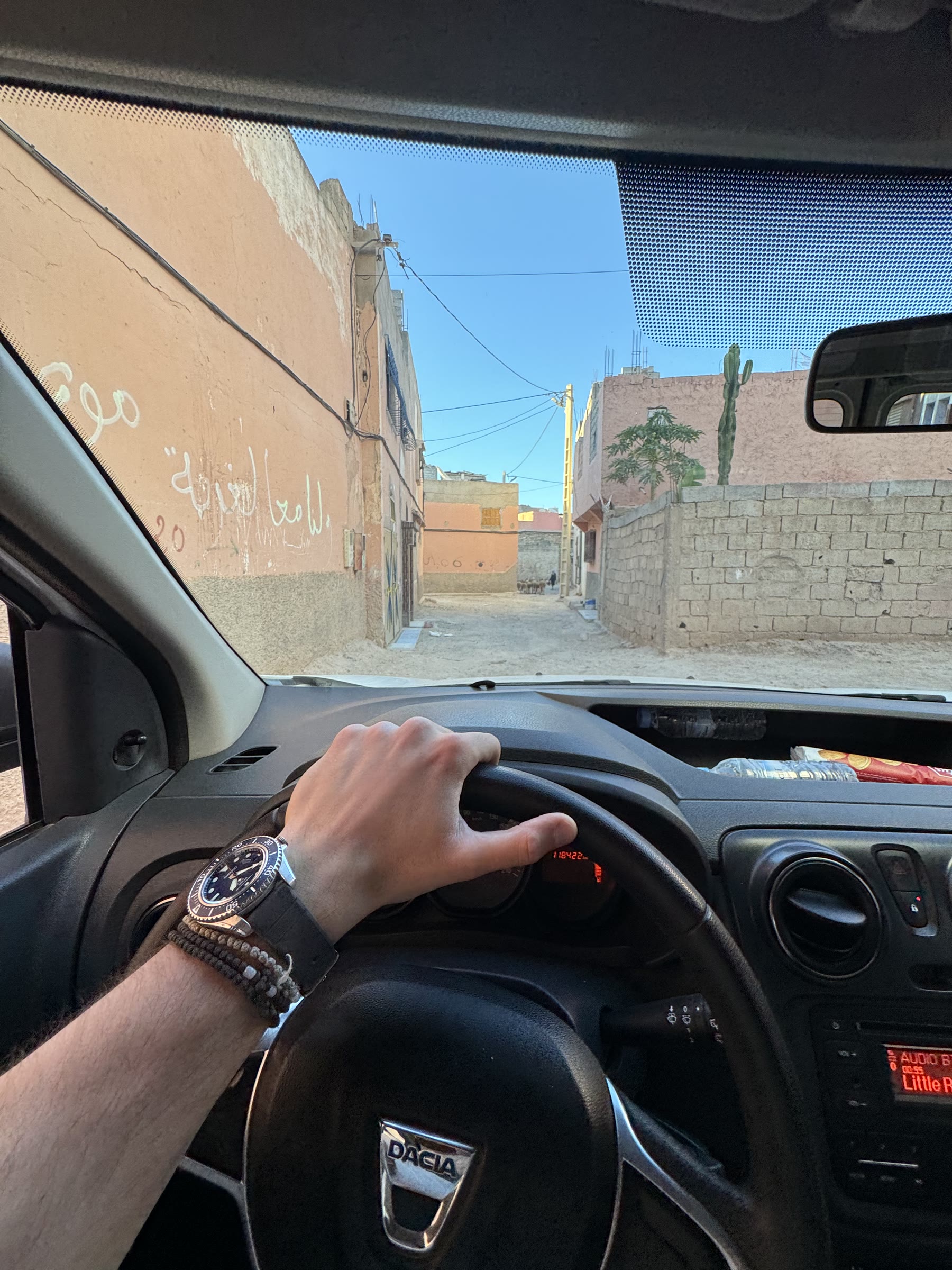
We killed the engine. And then we saw what the open door had done over five hundred kilometres.
The inside was a disaster. Dust on the dashboard, dust on the seats, dust layered on the boards, dust in places that defied explanation for how it got there. We'd driven four hundred kilometres with the AC on 18 and a ten-centimetre gap sucking the Atlantic ocean in with us.
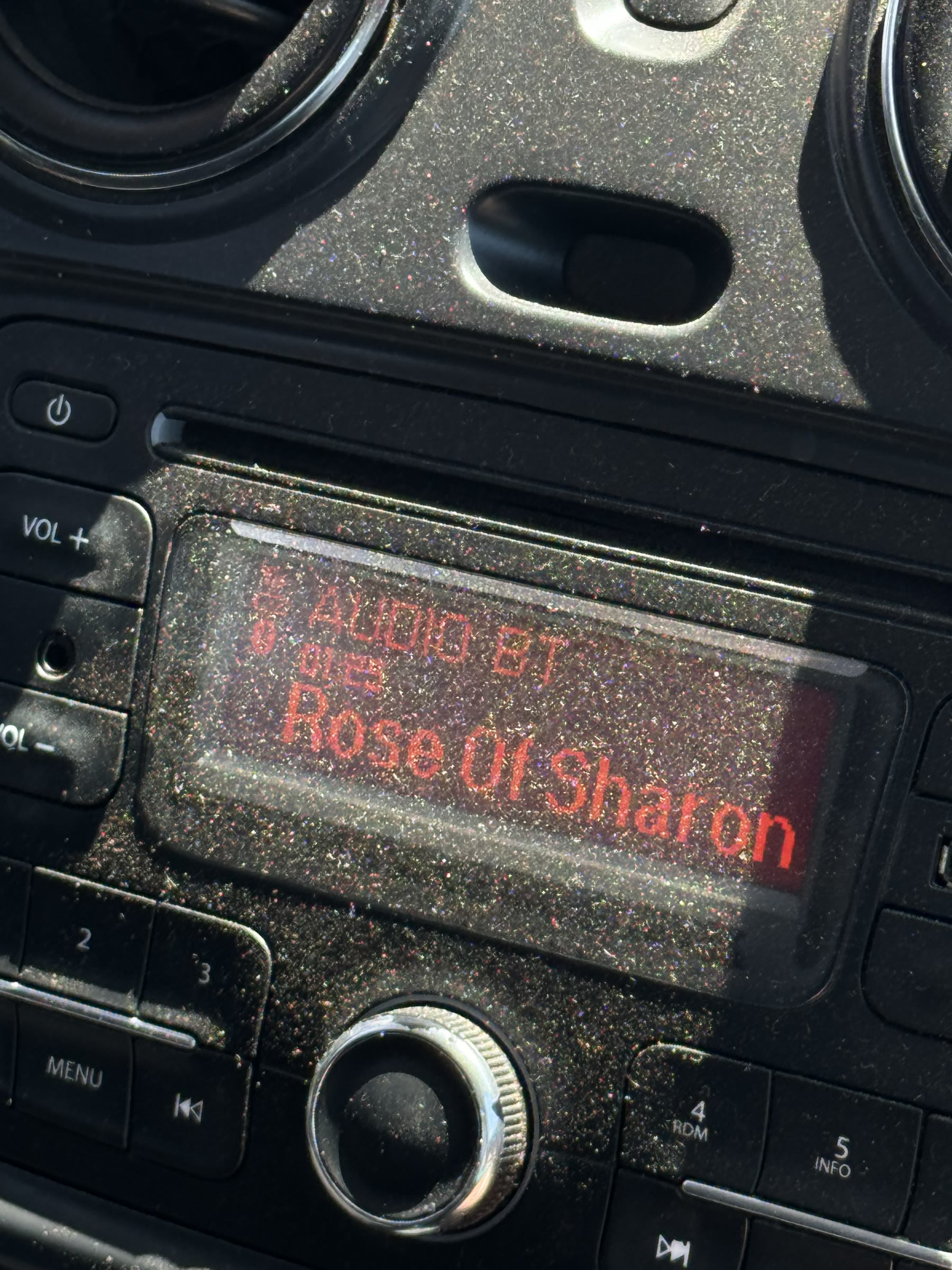
A little dust.
Taghazout is a fishing village on the Atlantic coast, a bit north of Agadir, which in recent years has become one of the great pilgrimage sites of European surf. White and blue houses climbing a hillside, a road running down to the beach, and the Atlantic sending sets that never stop.
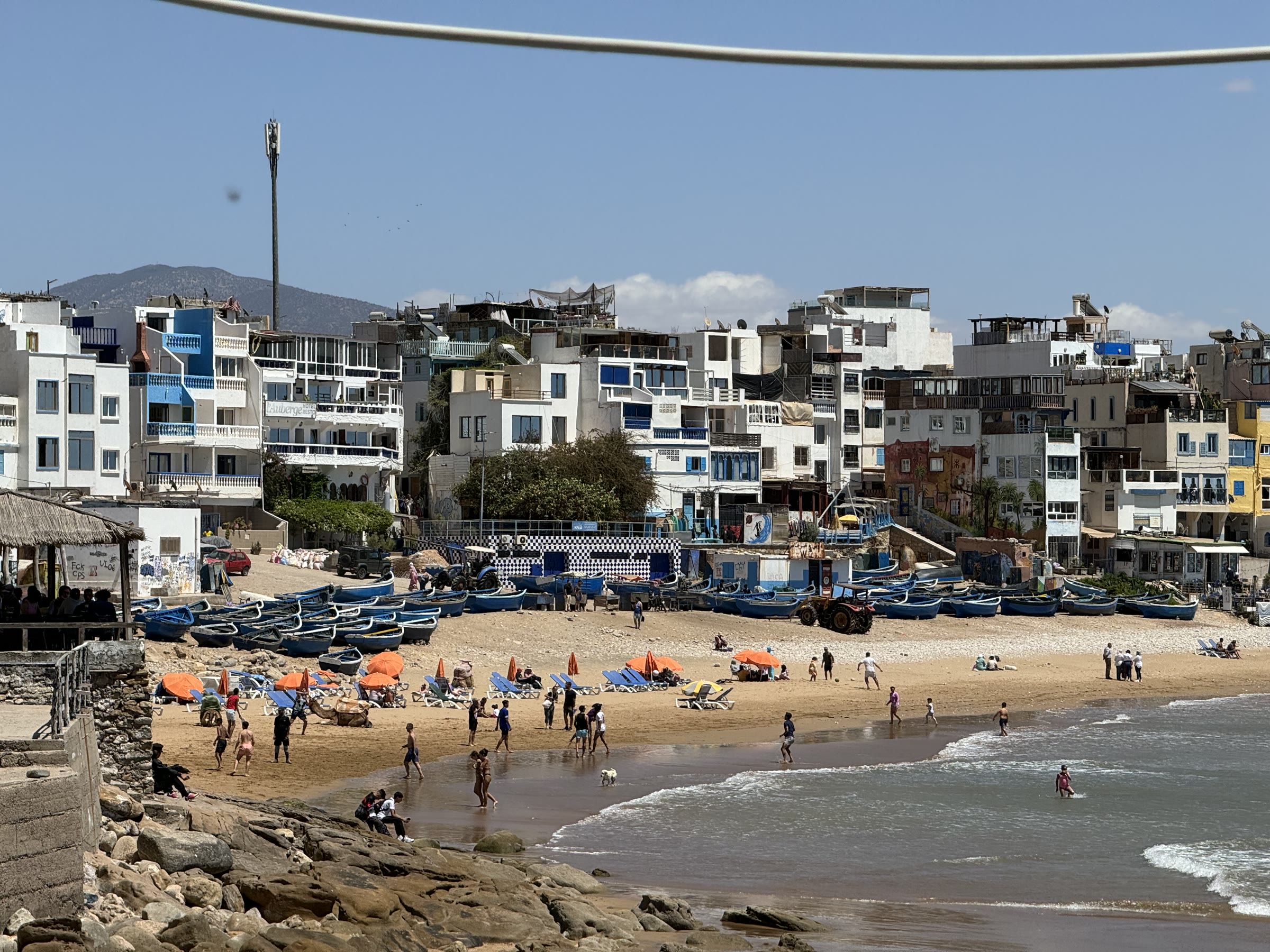
And inside that, two villages sharing the same address.
Up top, the surf camps and hostels: twenty- and thirty-somethings from Germany, England, France, Scandinavia, wetsuits hanging on railings, smoothie bowls, yoga on rooftops, laptops open in cafés with English names.
Down below, the village: cafés with chairs turned toward the street - same logic as Marrakech - boats pulled up onto the sand, shops selling spare parts, people who work at the camps and then walk home two streets over.
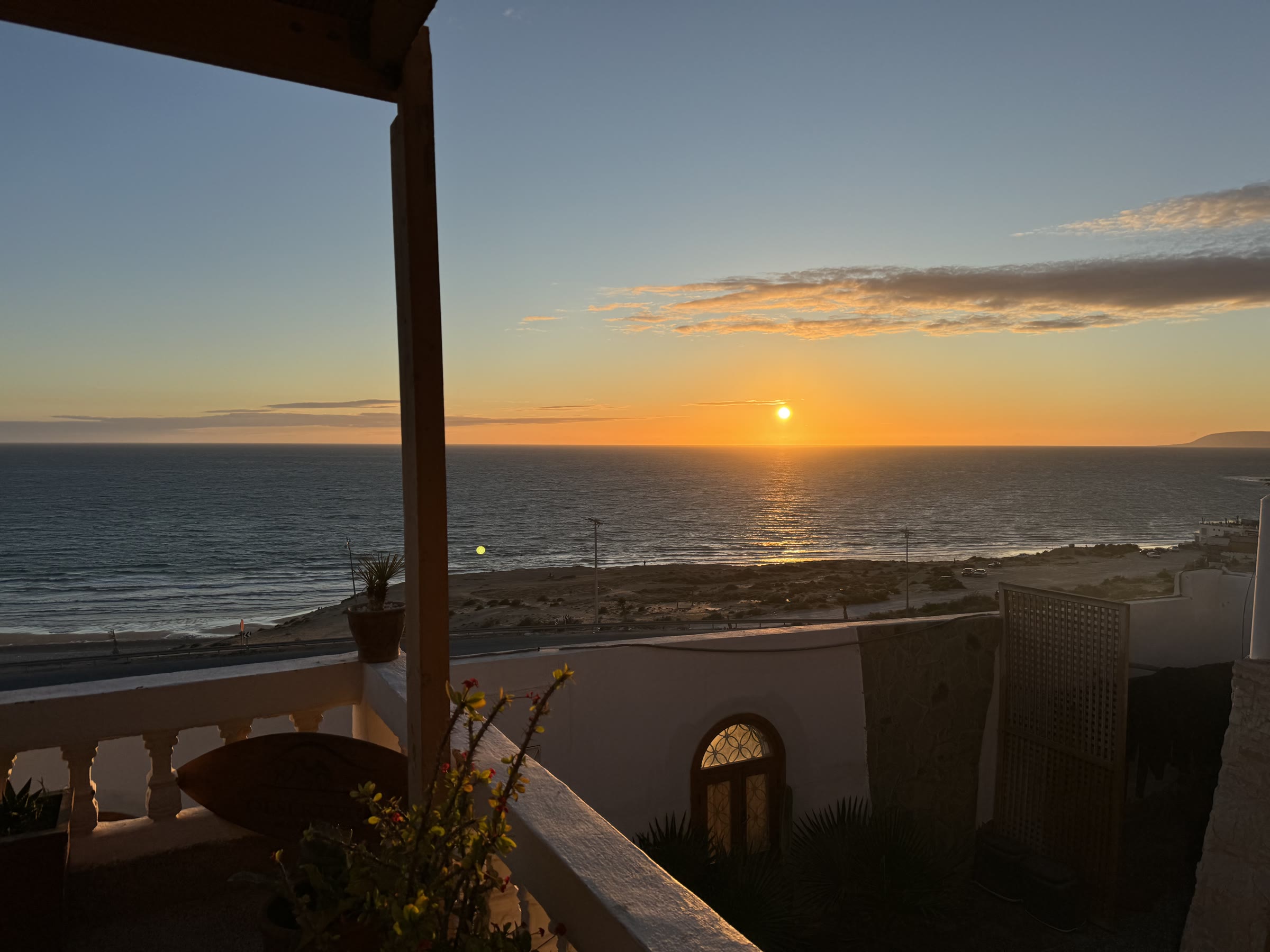
The two worlds keep crossing and rarely speak. The surfers pay for lessons, the locals give them. The surfers photograph the sunset, the locals have already seen it. There's no tension - there's simply a pane of glass between them, and everyone has silently agreed not to break it.
Over the next few days, the Dokker proved to be a proper donkey. It carried the boards, our hopes, and whatever was left of our egos after each session.
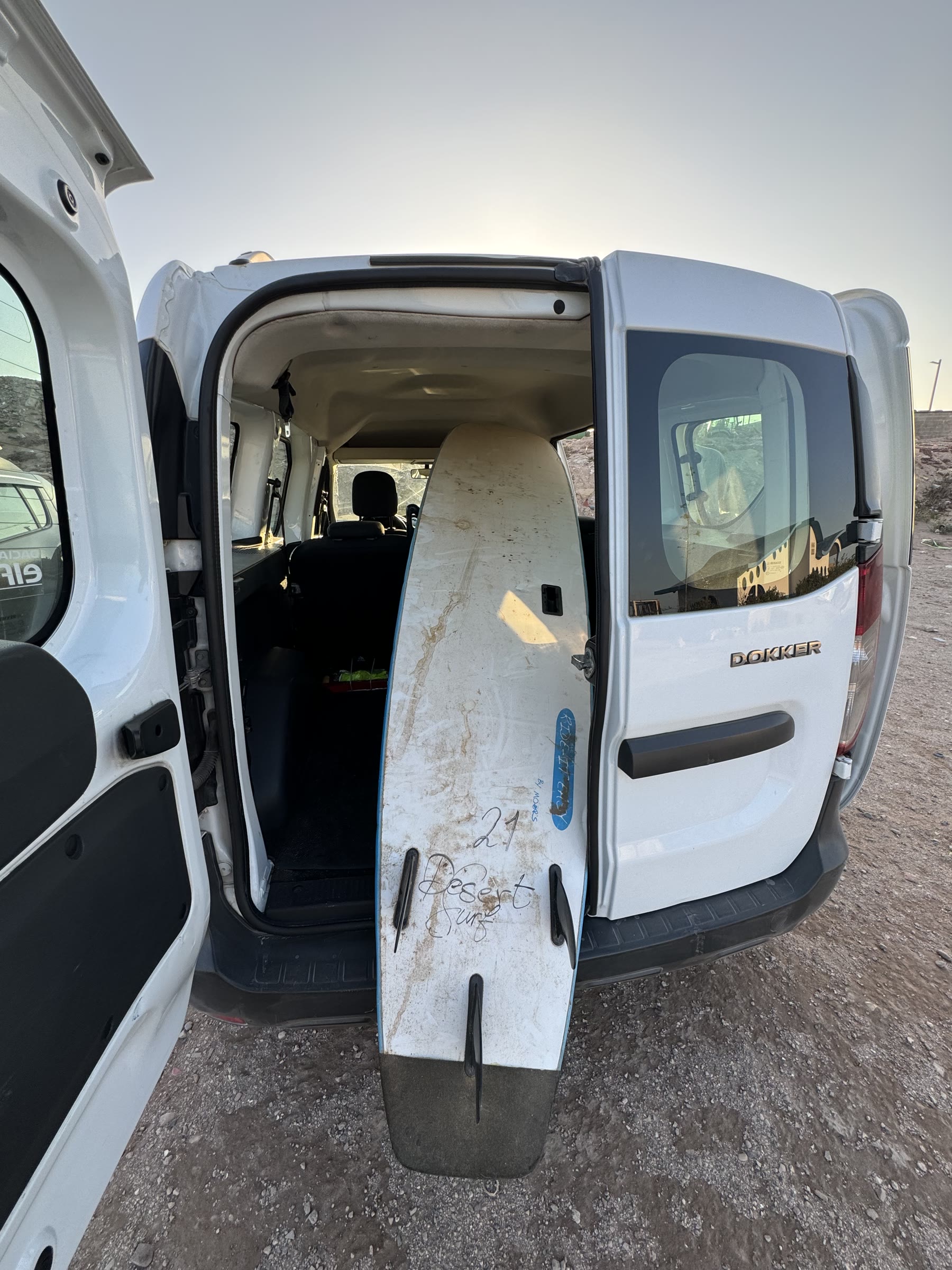
And something else, which we noticed slowly. Wherever we parked it, someone was sitting on it. On the side, on the back, on the bumper - grown-ups waiting for someone, kids resting there for a couple of minutes, one guy who smoked an entire cigarette perched on our wing.
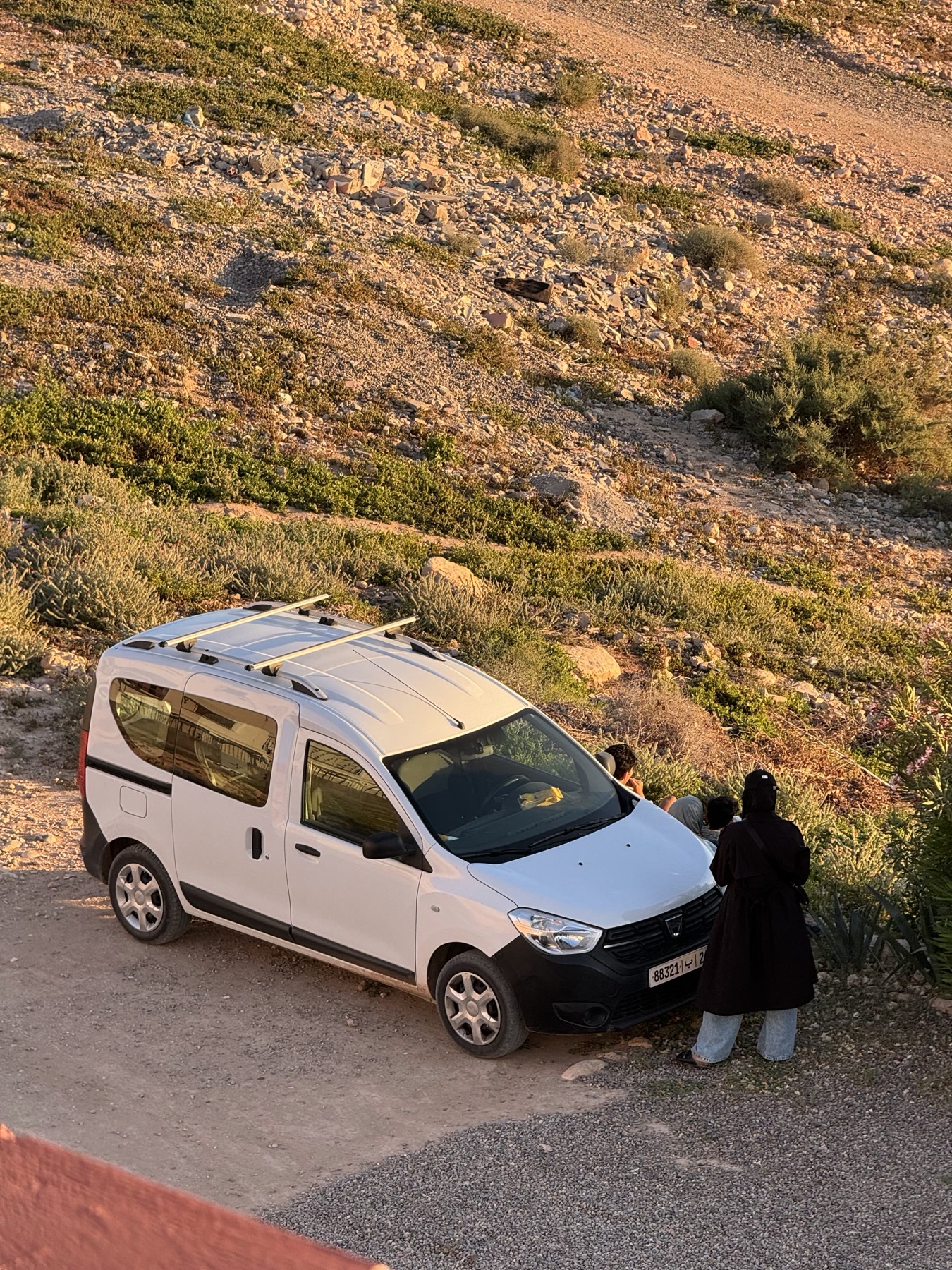
The first time it threw us. Then we understood: the Dokker wasn't a foreign car. It was just another white van in a village full of white vans. It didn't deserve a second glance, and that's exactly why it deserved to be sat on.
20 euros
One afternoon, coming back from a particularly mediocre session - a mediocrity that, let's be clear, had nothing to do with the waves and everything to do with us - we drove through a vacant lot.
Fifteen kids, maybe ten years old, were playing with a ball that had seen a lot more life than it looked capable of holding together. Worn through, half-deflated, patched the way things get patched when there's no second one coming.
The ball rolled toward the car. And the car, in turn, ran it over.
The sound was small. The silence after wasn't.
Fifteen kids. Thirty eyes. And the look that doesn't even blame you - it just watches you, because the afternoon just ended, and so did tomorrow's, and whatever came after that. I've never felt more guilt over something smaller.
We pulled out 20 euros and gave it to them.
The Dokker was immediately surrounded by ten-year-olds slapping its sides and cheering us on like we'd done something heroic. It took us a moment to understand why the joy was so out of proportion to the damage we'd caused.
We hadn't given them one ball. We'd given them five.
For the amount you leave on the table for a breakfast and never think about again, a vacant lot in Taghazout had its problem solved for the rest of the year. It's not a pretty realisation, that. It's simply the truth about where we stood and where they stood, and about how the exact same act can be nothing on one side of a lot and an entire holiday on the other.
We got a round of applause for damage we'd caused ourselves. And, to my shame, I enjoyed it.
The return
Three days later, the Dokker took us back to Marrakech. The crooked door never did close. The AC kept fighting an air that got in regardless. The tyres were whatever was left of tyres.
We'd considered, when we made the booking, getting something serious. An X1, something like that.
Nobody sits on a rented X1.
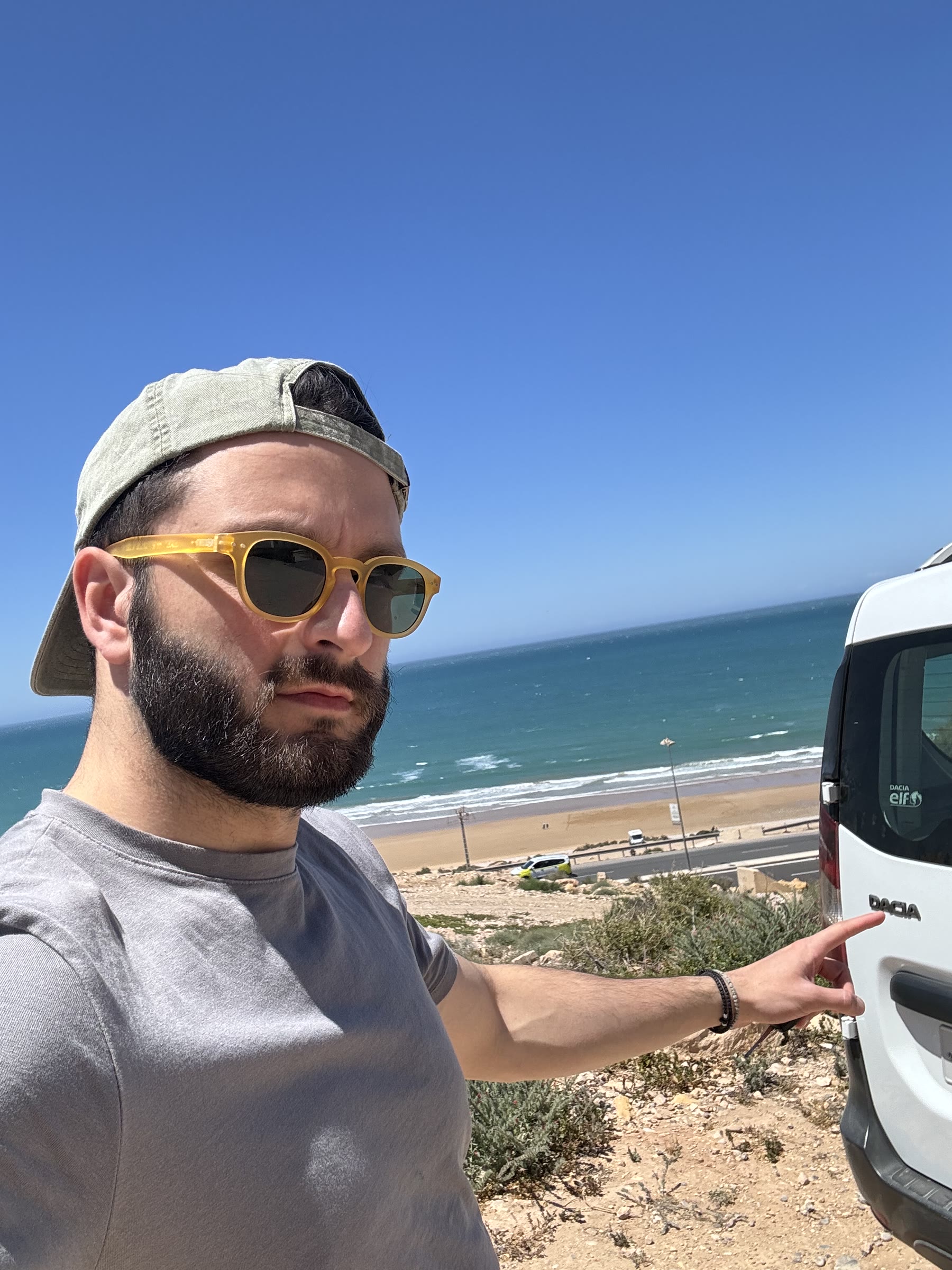
Four hundred instead of two hundred fifty, then. More expensive than we expected, worse than it could have been, and it did its job without complaint, in a country where it was born.
Sometimes cheap turns out expensive. And sometimes it's worth it.
Comments
Sign in to comment
- No comments yet. Share your thoughts.
Related stories
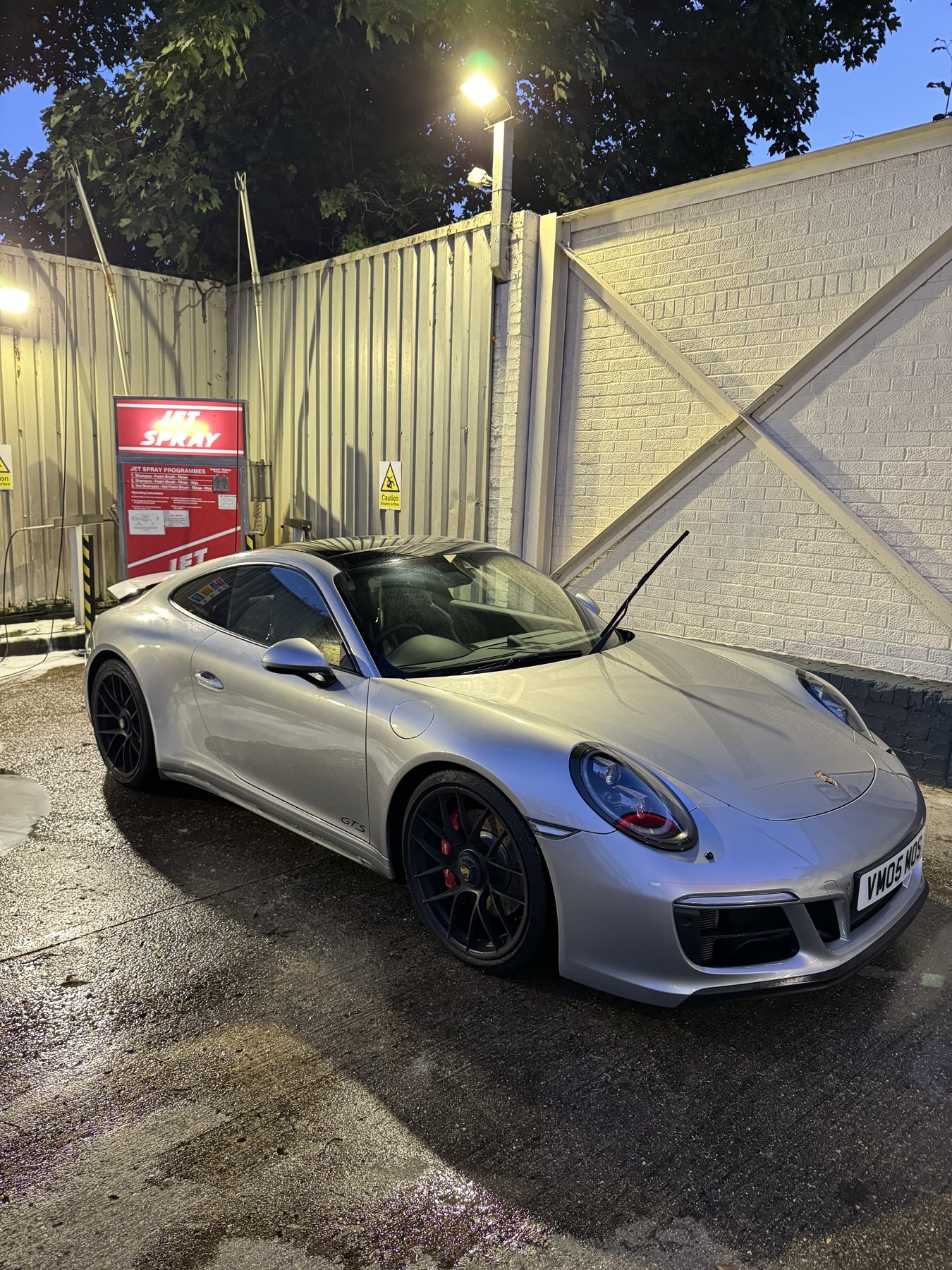
LONDON TO TUSCANY IN A PORSCHE 911: THE ROAD TRIP YOU HAVE TO DO ONCE IN YOUR LIFE
Fifteen days, 2,500 kilometres, a silver 911 Carrera GTS, and Alessandra in the passenger seat. From London, through the Eurotunnel, Paris and Burgundy, to the hairpins before Tuscany - with a stop at a French petrol station that nearly ended it all. Part one of two.Read the story
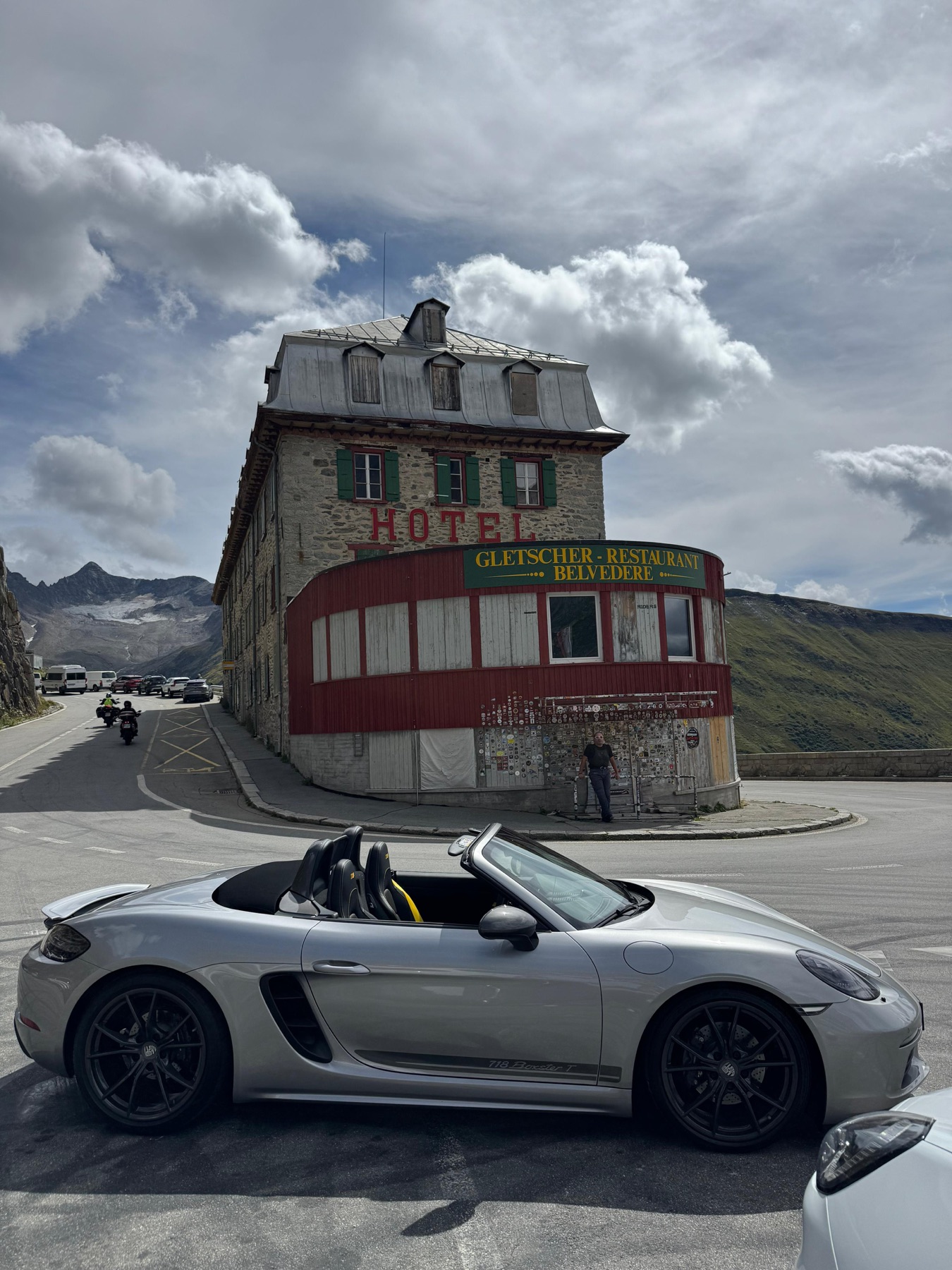
I WENT TO GERMANY MYSELF TO COLLECT THE PORSCHE. I WOULD NEVER PAY SOMEONE TO BRING IT TO ME.
How hard is it really to import a car from Germany yourself? The story of my third personal import - Autobahn, Swiss passes and a ferry across the Adriatic - and everything you need to know before you bring your own.Read the story
THE NÜRBURGRING IS CLOSER THAN YOU THINK - A ROAD TRIP FROM GREECE TO THE GREEN HELL
Costs, the route, practical tips - everything I wish I'd known before setting off, and the stories no onboard video can show you. The Nürburgring is closer than you think.Read the story
If you'd like to write your own story - submit it here